
The Family Navigation Project’s Core Components
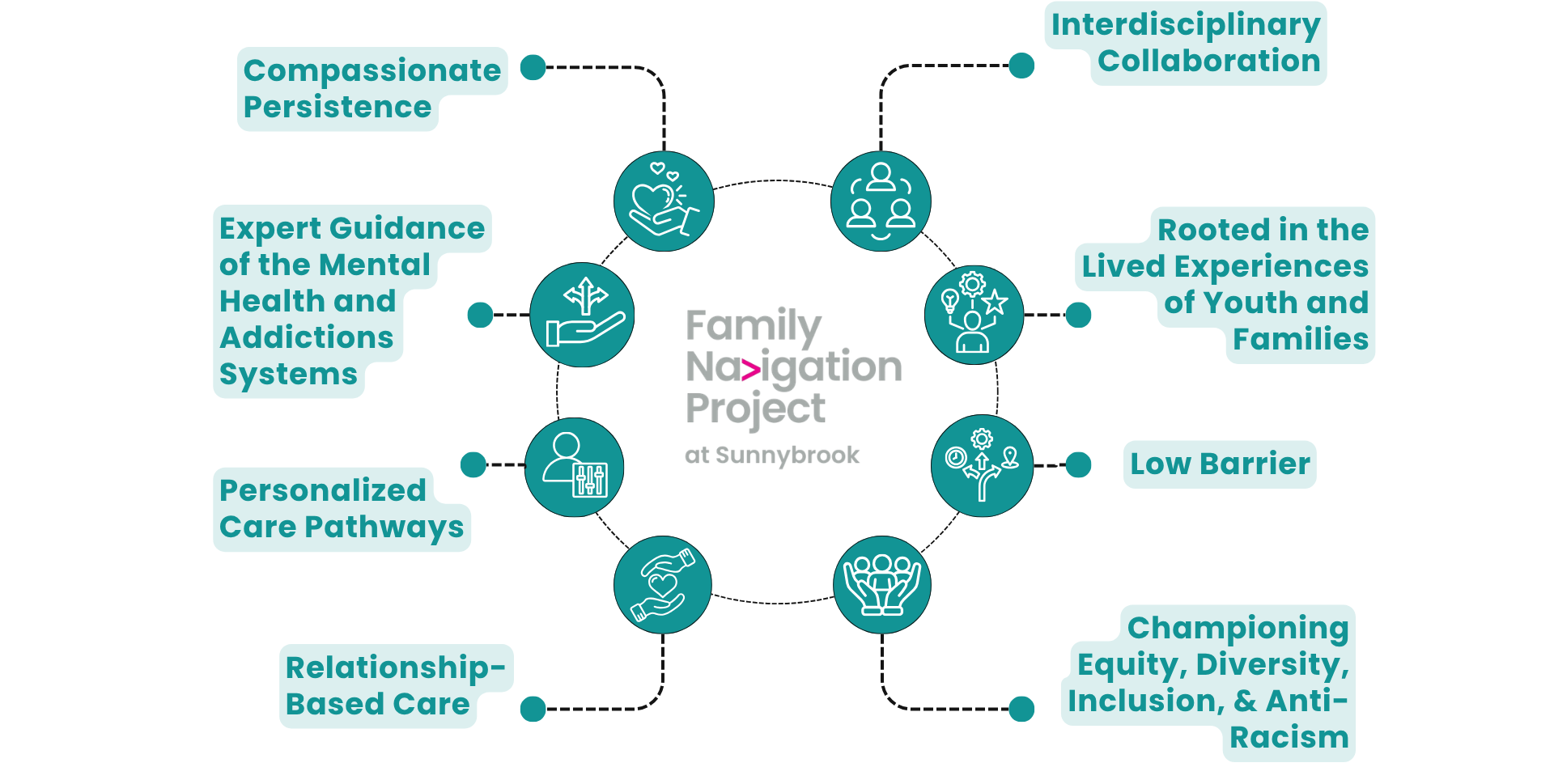
When implementing a service, it is important to identify its core components. Core components refer to the indispensable, non-negotiable elements that, if removed, would fundamentally alter the service. In the case of the Family Navigation Project (FNP), our core components are what make FNP, FNP.
Establishing a new FNP site in Sudbury and Manitoulin through the BEAM study created the impetus for initiating the process of identifying FNP’s core components. Identifying the core components of the FNP model allowed our team to determine what features of the model would remain the same across sites, to support the consistent application of the model and reliable outcomes.
A co-design process was used to identify the core components. Through extensive engagement with FNP interest-holders, including management, frontline, research, and operations staff, and youth and family advisory councils, key features of the FNP service were identified and refined. This process included five steps:
- Identification and extraction of preliminary component sources
- Knowledge generation and interest-holder input
- Conceptual analysis and core component identification
- Member checking
- Finalization of core components
Eight core components fundamental to FNP were identified through this process, each with corresponding definitions to describe their essential functions. These core components are:
- Compassionate Persistence: Foster hope and enable long-term engagement through consistent and ongoing follow-up. Demonstrate perseverance in finding the right fit for each youth and family. Provide navigation support with no time limits and welcome youth and families to seek help again if needed.
- Interdisciplinary Collaboration: Employ a team-based approach that goes beyond organizational boundaries to deliver integrated and coordinated care for youth and families. Unite diverse perspectives and promote innovative problem-solving by combining clinical, professional, research, and lived expertise.
- Low Barrier: Prioritize accessibility, inclusivity, responsiveness, and adaptability. Ensure youth and families can easily and equitably take part in navigation.
- Rooted in the Lived Experiences of Youth and Families: Create meaningful relationships with youth and family of choice. Program design and activities, decision-making, service delivery, and research embed youth and families’ lived expertise.
- Personalized Care Pathways: Match care to the unique needs, strengths, and experiences of youth and families. Navigation is flexible and collaborative, to address individual and systemic barriers. Emphasis is placed on understanding and addressing all aspects of wellness.
- Expert Guidance of the Mental Health and Addictions Systems: Build and maintain real-time awareness and knowledge of the mental health and addictions systems. Utilize system awareness and knowledge to provide comprehensive, informed guidance and advocate for youth and families.
- Relationship-Based Care: Cultivate dynamic relationships among all partners in a youth’s care, such as youth, family of choice, navigation team members, and service providers. Promote communication, collaboration, and wellbeing among all involved.
- Championing Equity, Diversity, Inclusion, & Anti-Racism: Embrace diverse perspectives and foster safe, inclusive, culturally responsive, and equitable care. Address systemic barriers and promote trust and respect through anti-racist and anti-oppressive approaches.
What do these core components look like in practice? How can we apply them in our work? To answer these questions, the core components were then used to develop practice profiles, as guided by NIRN. Practice profiles outline the optimal use, minimal use, and unacceptable use of the core components in practice. These practice profiles have been further adapted into a job aid, which will support the orientation and training of FNP team members at the Sudbury-Manitoulin site and beyond.
The core components capture the essence of FNP and will ensure its foundational integrity is maintained during implementation in Sudbury-Manitoulin. This will also support the future scale and spread of FNP across different contexts and settings. The co-design approach highlights the importance of collaboration in adapting successful models to new environments and exemplifies a strategy that can be adapted by other programs seeking to implement their services in new jurisdictions.
Interested in learning more or sharing this information with someone? Check out our two-pager on FNP’s core components, available in English and French.
For a detailed account of the process of identifying FNP’s core components, check out our manuscript published on topic here.
1 Interest-holders is a term that was introduced by Akl, Khabsa, and Petkovic et al (2024) to describe groups with legitimate interests in the health issue being examined. Their interests are based on the fact that members of these groups either make health-related decisions or are impacted by these decisions. Learn more here: Akl EA, Khabsa J, Petkovic J, et al. “Interest-holders”: a new term to replace “stakeholders” in the context of health research and policy. Cochrane Ev Synth. 2024;2:e70007. doi:10.1002/cesm.70007